news
An Art Book Fair of Art Book Fairs
Join us at Ca’Buccari for the Venice edition of the Mexico City-based Index Art Book Fair, with a new and unprecedented format: an Art Book Fair of Art Book Fairs!
For their inaugural Venice edition, Index Art Book Fair will bring sixteen art book fairs from around the world presenting their personal selection of art and artists publications, accompanied by an exciting public program.
Opening hours:
Thursday 4-8pm
Friday-Saturday, 12-8pm
Sunday, 12-7pm
Index Art Book Fair (MX)
African Art Book Fair (Dakar, SN)
An Independent Book Fair (Tirana, ALI)
Arts of the Working Class (Berlin, DE)
Bergen Art Book Fair (Bergen, NO)
Books are Bridges (Rotterdam, NL)
Borderless (Istanbul, TR)
Cairo Art Book Fair (Cairo, EG)
Fair Enough (Tallín, EE)
I Never Read (Basel, CH)
Libros Mutantes (Madrid, ES)
Miss Read (Berlin, DE)
OAZA Collectiv (Zagreb, HR)
Taipei Art Book Fair (Taipei, TW)
Yogyakarta Art Book Fair (Yogyakarta, ID)
MULTIPLE ART DAYS becomes (Made Anywhere), a new scene of artistic publishing practices dedicated to objects with poetic reaction.
(Made Anywhere) responds to a need for encounters around objects that are sources of inspiration, creation, collection and observation; a decompartmentalization of artistic forms that sometimes escape the market and the institution. From research to archiving, creation takes free and inspiring forms, often editorialized: iconography, collections, recordings, notations, publications or archives.
Wed. + Thurs. + Fri. 11 - 18 hr / Sat. 11 - 16 hr
einBuch.haus / Lindenstr. 91, 10969 Berlin *NEW ADDRESS*

Print on demand has revolutionized publishing. Digital printing and online platforms such as Blurb, Lulu and Kindle Direct Publishing allow anyone to publish a work immediately and without financial risk. These books come with an industrial look and feel and global distribution. This has undoubtedly democratized production and opened up spaces beyond the established trade book world and its gatekeepers. At the same time, new dependencies emerge. This dynamic has given rise to an entire subculture that engages with print on demand in search of new aesthetics, economies, and publics, while also critically negotiating our postdigial present and its monopolies.
The Library of Artistic Print on Demand maps this experimental field for the first time and explores its ethical implications, critical poetics, historical depths and political relevance. It consists of a collection of more than 244 outstanding works preserved by the Bavarian State Library, a searchable online archive and an extensive catalogue with contributions by leading practitioners and scholars of the field published by Spector Books.
einBuch.haus will show a respective selection of the Library of Artistic Print on Demand: books as a medium to monitor and utilize technological change, books as memes, books materializing formerly impossible concepts, books that were produced via outsourcing or algorithms, books as hacks or containers for ephemeral digital cultures, books that tackle our fatigue in the face of an all-encompassing platform capitalism.
Annette Gilbert researches experimental forms of writing, artists’ books, and conceptual art. Andreas Bülhoff works both artistically and academically at the intersection of text and technology.
List of Participating Artists from the collection Library of Artistic Print on Demand
Hartmut Abendschein, Greg Allen, Anonymous, Åbäke, Hannes Bajohr, Nanni Balestrini, Hester Barnard, Fred Benenson, Olivier Bertrand, Mimi Cabell, Étienne Candel, Francesca Capone, Giulia Ciliberto, Paolo Cirio, Albert Coers, Artists’ Books Cooperative, Felipe Cussen, Kris De Decker, Karen ann Donnachie, Kavi Duvvoori, Geraint Edwards, Jasper Otto Eisenecker, Ben Fry, Angela Genusa, James Goggin, Frank Philippin, Studierende des Fachbereichs Gestaltung der Hochschule Darmstadt, Mishka Henner, Elaine W. Ho, David Horvitz, Jason Huff, Jason Jadick, Marina Kampka, Jean Keller, Dagmara Kraus, Paul Laidler, Joyce S. Lee, Silvio Lorusso, Nicolas Maigret, Michael Maranda, Holly Melgard, Luca Messarra, Julian Palacz, Beatrix Pang, Kathrin Passig, Michalis Pichler, Vanessa Place, AND Publishing, Jake Reber, Aaron A. Reed, Maria Roszkowska, Rafaël Rozendaal, paula roush, Zoë Sadokierski, Joachim Schmid, Sebastian Schmieg, Andy Simionato, Danny Snelson, Paul Soulellis, Mark Staniforth, Isabelle Sully, Chris Sylvester, Stephanie Syjuco, Kyndal Thomas, Ubermorgen, Stéphanie Vilayphiou, Angie Waller, Thomas Walskaar, Barron Webster, Gregor Weichbrodt, Yin Yin Wong, Joey Yearous-Algozin, Rahel Zoller, Hermann Zschiegner, Erin Zwaska
Print-on-Demand hat die Welt der Bücher revolutioniert: Seit Anfang des Jahrtausends treffen immer bessere und günstigere Digitaldruckverfahren auf die Möglichkeiten des globalen Online-Handels. Daraus entsteht eine Produktionsmethode, bei der Bücher nicht mehr auf Vorrat vervielfältigt werden. Sie werden erst gedruckt, wenn konkreter Bedarf besteht: „on demand“, also auf Nachfrage.
Digitale Plattformen wie Kindle Direct Publishing, Blurb oder Lulu prägen aktuell die Produktion von Books-on-Demand im Selfpublishing-Segment. So wird es prinzipiell allen ermöglicht, ihre Arbeiten sofort und weltweit zu publizieren, ohne dafür auf einen Verlag angewiesen zu sein und ohne große finanzielle Risiken eingehen zu müssen. Die Bücher lassen sich mit wenigen Klicks erstellen und in den globalen Buchhandel einspeisen. Dies eröffnet einen Raum voller Möglichkeiten jenseits des klassischen Buchmarkts und trägt zur Demokratisierung der Produktion bei. Dabei werden etablierte Gatekeeper umgangen und alte Wertzuschreibungen aufgehoben; zugleich entstehen aber neue Abhängigkeiten, etwa von den Plattformen und deren Vorgaben und Interessen.
Vielfach beklagt wird auch der inhaltliche Qualitätsverlust, wenn alle alles drucken können. Zudem sind Digitaldruck und Bindung häufig nicht hochwertig, und die Fehlerquote in der vollautomatisierten Produktion ist recht hoch. Im Gegenzug ermöglichen die Print-on-Demand-Plattformen Teilhabe und Experiment und öffnen das Buch für neue Anwendungs- und Denkbereiche. Diese Dynamik hat eine lebendige Subkultur im Bereich künstlerischen Publizierens entstehen lassen, die das Medium Buch auf der Suche nach möglichen Inhalten, Ästhetiken, Materialitäten, Ökonomien und Öffentlichkeiten neu auslotet, gleichzeitig unsere digitale Gegenwart kritisch hinterfragt und verhandelt.
Die Bücher zeigen, wie sich diese innovativen Produktions- und Publikationsbedingungen kreativ nutzen lassen, dabei aber auch explorativ eingesetzt und differenziert reflektiert werden. Zugleich demonstrieren sie die ungebrochene Strahlkraft und Relevanz des gedruckten Buchs.
KONTEXT
Die „Library of Artistic Print on Demand“ kartografiert mit 244 Titeln erstmals dieses Experimentierfeld. Sie erkundet dessen globale Verbreitung, historische Tiefe und politische Relevanz. Alle Publikationen sind in einem Webarchiv umfassend dokumentiert zugänglich. Seit 2024 werden all diese Bücher von der Bayerischen Staatsbibliothek (Künstlerbuchsammlung) in physischer Form bewahrt und können dort im Lesesaal eingesehen werden. Ein umfassender Katalog mit Aufsätzen von Personen aus Theorie und Praxis erscheint bei Spector Books, Leipzig.
Die „Library of Artistic Print on Demand“ geht auf ein Forschungsprojekt von Annette Gilbert und Andreas Bülhoff an der Friedrich-Alexander-Universität Erlangen-Nürnberg zurück (2019–2022). Es wurde von der Deutschen Forschungsgemeinschaft gefördert. Die Auswahl der über 110 hier versammelten und einsehbaren Bücher kuratierte Annette Gilbert. In jedem Exemplar befinden sich Zettel mit der Beschreibung des jeweiligen Projekts auf Deutsch und Englisch.
Weitere Informationen finden Sie auf www.apod.li einsehbar.
BETEILIGTE KÜNSTLER*INNEN
0x0a, Åbäke, ABC (Artists’ Books Cooperative), Hartmut Abendschein, Greg Allen, AND Publishing, Anonymous, Hannes Bajohr, Nanni Balestrini, Hester Barnard, Fred Benenson, Olivier Bertrand, Christian Bök, Mimi Cabell, Étienne Candel, Francesca Capone, Giulia Ciliberto, Paolo Cirio, Albert Coers, Felipe Cussen, Kris De Decker, Alexia de Visscher, Eric Doeringer, Karen ann Donnachie, Geraint Edwards, Jasper Otto Eisenecker, Ben Fry, Gauss PDF, Angela Genusa, James Goggin, Mishka Henner, Elaine W. Ho, David Horvitz, Jason Huff, Intern, Jason Jadick, Marina Kampka, Jean Keller, Dagmara Kraus, Paul Laidler, Maxime Le Bon, Joyce S. Lee, Silvio Lorusso, Nicolas Maigret, Michael Mandiberg, Michael Maranda, Holly Melgard, Luca Messarra, Joseph Mosconi, NUPoD2017 Collective, Julian Palacz, Beatrix Pang, Kathrin Passig, Frank Philippin, Michalis Pichler, Vanessa Place, Jake Reber, Aaron A. Reed, Maria Roszkowska, paula roush, Rafaël Rozendaal, Zoë Sadokierski, Joachim Schmid, Sebastian Schmieg, Andy Simionato, Danny Snelson, Paul Soulellis, Mark Staniforth, Students of the faculty of Design at the University of Applied Sciences Darmstadt, Isabelle Sully, Surfaces Utiles, Stephanie Syjuco, Chris Sylvester, Kyndal Thomas, Elisabeth Tonnard, Troll Thread, Ubermorgen, Undocumented Press, Stéphanie Vilayphiou, Angie Waller, Thomas Walskaar, Barron Webster, Gregor Weichbrodt, Yin Yin Wong, Joey Yearous-Algozin, Hermann Zschiegner, Erin Zwaska.
Preview: June 12th, 2024, 15:00 - 18:00
Fair / Exhibition: June 13th - 16th 2024, 11:00 - 18:00
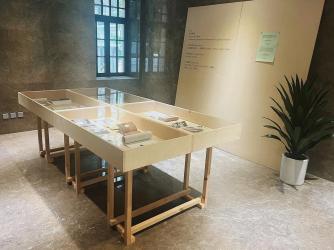
In late October 2023 Miss Read was approached by the head of the library of Goethe-Institut China, asking for advise in order to start a collection of the “Indie-print Szene/Zine-Szene”, which were to be permanently exhibited in the space of Goethe-Institute, located
in the art quarter 798 in Beijing.
One of the strong networks that have appeared in the 21st century are Art Book Fairs. Eventually, we agreed, that Miss Read would tap into its network and invite recent exhibitors at the fair, who could qualify or even had self-declared as Zine makers.
Our working definition of Zine is: a publication that is stapled and that is rather inexpensive. And often self-published and within the realm of cultural activism. With zines, legal control over the distribution, exhibition, and exchange of artworks is less left to art dealers or book distributors. On the contrary, in autonomous publishing, especially indie publishing and zine culture, this division of labor is reversed, with artists and authors taking on a variety of different and related roles: creators, designers, producers, printers, publishers, and distributors.
Our definition of Zines also includes publishers, artists or collectives, who self-define their practice to lay within the realm of zines.
Curated by Michalis Pichler and coordinated by Julia Gwendolyn Schneider for Miss Read.
Exposition littéraire autour de Mallarmé, recalls an exhibition of the same name by Marcel Broodthaers in 1969 at Wide White Space in Antwerp, Belgium. The exhibition is centered around re-readings and re-writings of Un Coup de Dés Jamais N’Abolira Le Hasard across different media, around that icon of the avant-garde. The exhibition will be a 1-on-1 appropriation of a historical exhibition, hence a “greatest hit” in its own right.
Coup de Dés (Collection) unites a vast number of editions of Mallarmé’s chef d’oeuvre as well as many of its historical and contemporary editions and appropriations by other authors such as Claude Balif, Fritz Balthaus, Derek Beaulieu, Jérémie Bennequin, Christopher Brennan, Marcel Broodthaers, Bernard Chiavelli, Jim Clinefelter, Lucien Desalmand, Mario Diacono, Sammy Engramer, Marie Louise Erlenmeyer, Cerith Wyn Evans, Ernest Fraenkel, Rodney Graham, Paul Heimbach, Angela Grasser, Barry Guy, Felix Philipp Ingold, La Bibliothèque Fantastique, Brian Larosche, Alexandra Leykauf, Benjamin Lord, Stéphane Mallarmé, Michael Maranda, Guido Molinari, Monchas, Francoise Morel, Nontsikelelo Mutiti, Aurélie Noury, Michalis Pichler, Henri Pousseur, Nicolas Richard, Mitsou Ronat, Sam Sampson, Camille Soula, Ultralab, Klara Vith, and Eric Zboya.
The collection also includes a variety of publications (backgammon tutorials, pulp fiction, and militaria books) that feature the phrase “Coup de Dés” on the cover without explicitly referring to Mallarmé. Coup de Dés (Collection) is ongoing and subject to open submission.
The exhibition includes Un Coup de Dés Jamais N’abolira Le HasardSCULPTURE, a close copy of the 1914 edition of Stéphane Mallarmé’s poem, but with all the words cut out by laser, in a way that corresponds directly to the typographic layout used by Mallarmé. When turning the pages, numerous shadows are generated by the cutouts. Pichler’s version is juxtaposed with editions by Broodthaers and Mallarmé, who had written Un Coup de Dés jamais n’abolira le Hasard. POÈME in 1897, and also saw it published in a magazine called Cosmopolis. Mallarmé left copious notes as to how it should be typeset, instructions that were finally carried out 16 years after his death, in 1914. In 1969 this work was appropriated in three renditions as Un Coup de Dés Jamais N’abolira Le Hasard. IMAGE by Marcel Broodthaers, who replaced the words by black stripes.
A glass version of Un Coup de Dés jamais n’abolira le Hasard. SCULPTUREis installed in the airspace of the gallery as a spatial installation or walk-through book, even though there is no text displayed on the plates. Through its “strategic illegibility,” it seems to establish what Jacques Derrida would call “a text, that is, a readability without a signified”.
Somewhere in the gallery, a player piano rocks away with a that somehow resembles aleatoric music. The turn-of-the-century pianola is indeed playing Un Coup de Dés Jamais N’abolira le Hasard. MUSIQUE, created by running a 288mm tracker roll of Pichler’s cut-out windows/verses.
The exhibition is accompanied by a Catalog with texts by Craig Dworkin, Annette Gilbert, Luc Boltanski, Arnaud Esquerre, Ryoko Sekiguchi, and Michalis Pichler, and reproductions of the works, co-published by Center for Book Arts and Spector Books in Germany.
“Review of “COUP DE DÉS (COLLECTION)”” by Robert Bolick on BooksonBooks: https://books-on-books.com/2024/03/19/review-of-coup-de-des-collection/
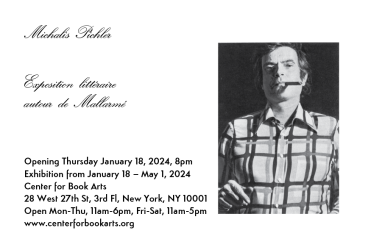
Exposition littéraire autour de Mallarmé, recalls an exhibition of the same name by Marcel Broodthaers in 1969 at Wide White Space in Antwerp, Belgium. The exhibition is centered around re-readings and re-writings of Un Coup de Dés Jamais N’Abolira Le Hasard across different media, around that icon of the avant-garde. The exhibition will be a 1-on-1 appropriation of a historical exhibition, hence a “greatest hit” in its own right.
Coup de Dés (Collection) unites a vast number of editions of Mallarmé’s chef d’oeuvre as well as many of its historical and contemporary editions and appropriations by other authors such as Claude Balif, Fritz Balthaus, Derek Beaulieu, Jérémie Bennequin, Christopher Brennan, Marcel Broodthaers, Bernard Chiavelli, Jim Clinefelter, Lucien Desalmand, Mario Diacono, Sammy Engramer, Marie Louise Erlenmeyer, Cerith Wyn Evans, Ernest Fraenkel, Rodney Graham, Paul Heimbach, Angela Grasser, Barry Guy, Felix Philipp Ingold, La Bibliothèque Fantastique, Brian Larosche, Alexandra Leykauf, Benjamin Lord, Stéphane Mallarmé, Michael Maranda, Guido Molinari, Monchas, Francoise Morel, Nontsikelelo Mutiti, Aurélie Noury, Michalis Pichler, Henri Pousseur, Nicolas Richard, Mitsou Ronat, Sam Sampson, Camille Soula, Ultralab, Klara Vith, and Eric Zboya.
The collection also includes a variety of publications (backgammon tutorials, pulp fiction, and militaria books) that feature the phrase “Coup de Dés” on the cover without explicitly referring to Mallarmé. Coup de Dés (Collection) is ongoing and subject to open submission.
The exhibition includes Un Coup de Dés Jamais N’abolira Le HasardSCULPTURE, a close copy of the 1914 edition of Stéphane Mallarmé’s poem, but with all the words cut out by laser, in a way that corresponds directly to the typographic layout used by Mallarmé. When turning the pages, numerous shadows are generated by the cutouts. Pichler’s version is juxtaposed with editions by Broodthaers and Mallarmé, who had written Un Coup de Dés jamais n’abolira le Hasard. POÈME in 1897, and also saw it published in a magazine called Cosmopolis. Mallarmé left copious notes as to how it should be typeset, instructions that were finally carried out 16 years after his death, in 1914. In 1969 this work was appropriated in three renditions as Un Coup de Dés Jamais N’abolira Le Hasard. IMAGE by Marcel Broodthaers, who replaced the words by black stripes.
A glass version of Un Coup de Dés jamais n’abolira le Hasard. SCULPTUREis installed in the airspace of the gallery as a spatial installation or walk-through book, even though there is no text displayed on the plates. Through its “strategic illegibility,” it seems to establish what Jacques Derrida would call “a text, that is, a readability without a signified”.
Somewhere in the gallery, a player piano rocks away with a that somehow resembles aleatoric music. The turn-of-the-century pianola is indeed playing Un Coup de Dés Jamais N’abolira le Hasard. MUSIQUE, created by running a 288mm tracker roll of Pichler’s cut-out windows/verses.
The exhibition is accompanied by a Catalog with texts by Craig Dworkin, Annette Gilbert, Luc Boltanski, Arnaud Esquerre, Ryoko Sekiguchi, and Michalis Pichler, and reproductions of the works, co-published by Center for Book Arts and Spector Books in Germany.
“Review of “COUP DE DÉS (COLLECTION)”” by Robert Bolick on BooksonBooks: https://books-on-books.com/2024/03/19/review-of-coup-de-des-collection/